How to Sell Things Online for Free: A Complete Guide
How to sell things online for free: compare local and shipped marketplaces, spot hidden fees, and build a listing that attracts buyers and keeps you safe.

In short
Selling things online for free means listing products on platforms without paying an upfront fee, often through local marketplaces or sites that charge only after a sale. Choose the platform that fits your item, check all selling, payment, and shipping costs, and create honest listings with clear photos, details, and competitive prices. Start small, protect yourself during transactions, and track profit so you can decide whether marketplaces are enough or an online store is worth the added work.
Think about a garage sale. Tables out front, a handwritten price on each item, and a few buyers who wander by. Selling online works the same way, just with a much bigger crowd.
The good news is that you can list real products without paying anything up front, as long as you know where the hidden costs live.
In this guide, we’ll cover where to list, what’s truly free versus fee-charged, how to write a listing that sells, and when your own store makes more sense than a marketplace.
Choosing What to Sell Online for Free
Before you snap a photo, match each item to the right place and check that buyers want it.
Pick the right site for each item
Each platform has its own crowd, so match the item to where its buyers shop:
- Furniture sells better locally, since bulky pieces are a pain to ship.
- Fashion sells better online, where shoppers search by brand and size.
- Collectibles suit eBay, where collectors hunt for specific items.
- Handmade goods suit Etsy, a marketplace built for makers.
Think of a retired teacher cleaning out her garage. The oak table goes to a local listing site for a neighbor to collect, the vintage cookbooks go to eBay, and the quilt she stitched goes to Etsy. Three sales, and no shipping on the heaviest item.
What tends to sell best
Some categories move faster than others:
- Furniture and home goods: lamps and side tables appeal to everyday buyers.
- Clothing and electronics: name-brand clothing and working gadgets draw a wide crowd.
- Collectibles and vintage: old toys and retro cameras attract a devoted following.
You don’t need a rare find. Start with unused items, like a gadget still in its box or a sweater with the tags on. They’re easier to photograph and describe honestly. Keep it simple.
Checking demand and competitors first
Start by finding in-demand products: search your category on the sites you’re considering and note what’s listed and how it’s priced.
Next, run a competitor analysis: look at similar sellers and ask what they do well, where they fall short, and what gap you could fill. A SWOT analysis, short for Strengths, Weaknesses, Opportunities, and Threats, helps you sort those answers.
For demand over time, try Google Trends, a free tool showing how often people search, plus Statista, which gathers market figures.
Finally, define your unique selling proposition: the one reason a buyer chooses your listing over the next. It’s less about what you sell and more about why buyers pick you.
Listing on several sites at once
List on several platforms to boost your chances of selling, since each item reaches more shoppers. A jacket that stalls on one site may sell on another. Track what’s sold so you don’t promise the same item twice.
Free Local Sites to Sell in Person
If you’re new to selling, here’s where we’d start. Local sites connect you with buyers nearby, so there’s no shipping to figure out. They differ in who’s browsing and how much trust they build, so match the platform to the item.
Selling on Facebook Marketplace
Facebook Marketplace is the one most first-time sellers already have open. You can list for free for local, in-person sales, and the built-in audience is huge.
For example, a college student selling a mini fridge can meet a buyer at a campus coffee shop and be done by lunch.
Facebook also offers a shipping option, but it comes with fees. The downside is scam and protection concerns: some buyers may push you to pay before you’ve seen the item. Meet in a busy public place and inspect the item before any money changes hands.
Craigslist for bulky items
Craigslist is the classic pick for bulky items like sofas and treadmills. It’s free for most categories, but some carry fees, so check the posting screen before you publish.
Craigslist has no built-in payments, so agree on how you’ll be paid before the buyer arrives.
Selling to verified neighbors on Nextdoor
Verified neighbors are the only people who can take part, so you’re dealing with people who live close by. There are no listing or selling fees, and sales happen through local meetups only. The trade-off is limited reach.
Nextdoor trades reach for trust, and your audience is your neighborhood, not the whole city. Smaller crowd, closer buyers.
Using OfferUp on your phone
OfferUp is a mobile-first app, so you can snap photos, write the listing, and reply to buyers without opening a laptop. Free local sales are the main draw, and you get ratings plus ID verification to help judge who you’re dealing with.
A nurse on a night shift could sell a spare bike from her phone during a break and have a buyer lined up before her shift ends. Activity varies by area, though, so a busy city may get replies quickly while a small town takes longer.
Selling with real-name profiles on VarageSale
VarageSale is built around real-name profiles, and each new member goes through a manual member review before joining. Listing and selling are both free, so posting a box of kids’ toys costs you nothing. Real names, real people on the other end.

Free Marketplaces for Shipped Sales
A marketplace brings the buyers to you, so you don’t have to build a store first. The options below are grouped by what you sell.
Sites that sell almost anything
Think of a retired teacher clearing out a garage: one big site can take a mixer, board games and a bike. Here’s what stands out:
- eBay. Its huge global audience means buyers far away can find your listing.
- Mercari. Built-in shipping labels keep postage inside the app.
- Free monthly listings. eBay’s free monthly listings let you test a few items at no cost.
- Almost any category. eBay covers collectibles, electronics, clothes, cars and more, as a research paper on seller experiments describes.
Apps for reselling clothes and fashion
Poshmark is built around social sharing, so shoppers can pass your listings along. Depop leans toward vintage and streetwear. Consider a college student selling thrifted jackets: Depop’s streetwear crowd is a natural fit.
Vinted charges buyers a buyer-paid protection fee, and Vinted’s help center confirms buyers pay it at checkout. So the buyer covers that fee, not the seller.
All three draw fashion-focused audiences, so shoppers arrive already looking for clothes.
Smaller sites that only charge after sales
SellWild takes a 10% commission, and that commission is capped, so a big sale won’t push it past the limit.
Swappa specializes in buying and selling used tech, and a research paper on trade-in programs describes platforms like it as a channel for selling used products.
Across these smaller sites, you pay only after a sale. Picture a hobby photographer listing an old lens: listing costs nothing, and a commission only applies if the lens actually sells. No sale, no bill.
What Selling Actually Costs You
Listing an item is often free. Selling it rarely is, so here’s where the money goes.
Free to list, fees after a sale
Most sites are free to list, but many charge once something sells. Local sales skip site fees altogether.
Payment processing fees are what you pay to handle a card payment. Check whether a site bundles them into its listed fees or bills them separately.
Payout timing and holds decide when money reaches your bank, which may be later than the sale date. Check each site’s payout schedule before you count on it.
Here’s how the main options compare:
| Where you sell | What it charges |
|---|---|
| Local sales | No site fee |
| Most free-to-list sites | Free to list, fee after a sale |
| Etsy | Listing and transaction fees |
| Amazon | Monthly seller plan |
| Ruby Lane | Monthly fee |
| Promoted listings | Optional boost fees |
Covering shipping costs and weight limits
Shipping catches first-timers off guard. Prepaid labels and flat rates lock in a price before the package leaves, and buyers typically pay shipping, so build it into your pricing.
Go over a site’s weight limit and you’ll pay extra. A candle maker whose glass jars push each box past that limit may find the surcharge eating her profit unless she weighs the box first.
Paid sites and optional extras
Four options come with their own charges:
- Etsy charges listing and transaction fees.
- Amazon has a monthly seller plan.
- Ruby Lane charges a monthly fee.
- Promoted listings and boost fees are optional extras that push your items in front of more shoppers.
Working out your profit and break-even
Startup expenses are one-time costs, like equipment and first supplies. Operating expenses recur, like plan fees and shipping.
Profit margin is what’s left of the price after every cost, as a percentage: subtract costs from the price, divide by the price, then multiply by 100.
Think of a potter selling mugs. Clay, glaze, and packaging, plus any marketplace fee and shipping, come out of each sale. Once she runs the math, a mug priced for her craft fair may be losing money online.
Break-even point is the number of sales that cover your expenses, so profit starts. Divide total expenses by what you keep per sale.
Run the numbers before you list, not after the first sale.
Create a Listing Step by Step
Buyers decide in seconds, so here’s how to get your photos, words and price right the first time.
Taking photos that sell
Good photos do most of the selling, and you don’t need fancy gear. Shoot a plain phone photo by a window, against a clean background like a white sheet, and take several angles.
Show the tags and flaws, not just the best angle. A retiree selling a vintage lamp shoots it by the kitchen window, including a close-up of the frayed cord. The buyer who shows up has already seen it, so there’s no haggling at the door.
Writing titles and item descriptions
Your title does the heavy lifting, so lead with brand, item type and size, like “Cast Iron Skillet, 10 Inch, Pre-Seasoned.” Include these details every time:
- Brand, size and model number, if you have one
- Condition in plain words, like “gently used”
- Every flaw, described honestly
Keywords are the words buyers type into a search box, so write for what they search for, not the names you use in your garage. Last, write copy that sounds like you: “Perfect for weeknight pancakes, and it’s been well loved.” Specifics sell.

Setting a fair price that sells
Start by checking similar listings, and notice which ones linger, since that often signals a price that’s too high. Then price competitively, or a touch lower. A slightly lower number often sells faster.
If it sits unsold, lower the price in small steps. A college student selling a used bike checks a few similar listings, lists just under the middle, and trims a little after a slow week.
Staying Safe and Protected as a Seller
Free listings are quick to post, and scammers know it. Here’s how to stay protected.
Spotting and avoiding scams
Open classifieds are where scams often show up. Watch for buyers who overpay and ask for the difference back. A retired teacher selling a used bike who gets that message can simply walk away and keep her money.
Check the buyer’s verified profile, where the platform offers one, plus their past activity, before you agree to anything. A brand-new account isn’t always a scam, but it deserves a closer look.
You’re checking who is on the other end, not just what they want.
Some platforms have staff who review listings, which can catch some fakes. Don’t count on that alone: read the listing rules and report anything that looks off.
What protects you when selling
A resolution center is the platform’s built-in dispute process, so keep every message inside the platform. That written record is what you’ll need if things go wrong. It helps you fix a problem, not avoid one.
Ratings and reviews work both ways. A buyer’s history shows who you’re dealing with, and your reviews help the next person decide about you. Ask for one after a smooth sale.
A local sale, where you take cash in person, usually comes with little platform protection. Once the item changes hands, a dispute is mostly between you and the buyer. That’s the trade-off for skipping shipping.
Choose a meetup spot that’s busy and well-lit, and bring a friend if you can. A hobbyist selling vintage records should pick a café in the afternoon, not a quiet parking lot at night. Public beats private. Every time.
Marketplaces or Your Own Online Store
Should you sell on a busy marketplace or in your own online store? Each one trades something different.
Why marketplaces are easier to start
- Built-in traffic. Shoppers are already browsing, so you don’t start from zero.
- Buyer trust and credibility. Buyers already trust the marketplace’s checkout, so you start with credibility.
- Low setup costs. You can start listing without building a website first.
- Validate products first. A few listings show what sells before you invest in a store.
Think of a retired teacher selling hand-knitted scarves for the first time. She can list them this weekend and learn whether anyone wants them before she builds anything.
Why your own store gives control
A store you run yourself puts you in charge, not the marketplace. Your brand’s colors, fonts and layout stay yours, and you keep your customers’ emails and order history.
Marketplaces usually take a fee on each sale, so your store can keep more of each price. You also choose the features and prices. The catch? You’ll bring the shoppers.
Online store builders and tools
Decide your store’s look first. Match the style to your brand before you pick a platform, since redesigning later takes time.
- Shopify store builder and Square Online store. Compare them on design, features and cost.
- Inventory sync across channels. Keep stock matching across your marketplace and store so you don’t sell one item twice.
- Checkout and payment options. Offer the payment methods shoppers expect, and check what each costs you.
- Free store plan limits. Free plans can cap products, features or sales, so read the limits before you commit.
Promoting and Growing Your Online Business
Listing is the easy part. Getting buyers to find you and come back is the real work.
Channels to reach more buyers
- Social commerce and shoppable posts: Tag products in your posts so buyers can tap straight through to the item.
- Google Shopping and SEO (search engine optimization): Write titles and descriptions in the words shoppers actually type, so your listings show up in search.
- Marketplaces: Shared sites with a built-in crowd. You gain traffic but give up some control over your brand.
- In-person to online: A candle maker who tucks a shop card into every bag at a farmers market turns those regulars into online buyers. They’re your easiest first customers.
Marketing ideas that bring in buyers
- Paid social ads: Sponsored posts you pay to show to a chosen audience. It’s the one fee-charged idea in this group, so set a spending limit first.
- Email and SMS (short message service) lists: Keep the addresses and numbers of people who said yes to hearing from you, and use them for restocks and sales.
- Coupons and loyalty programs: Coupons bring first-timers in, and loyalty rewards bring them back.
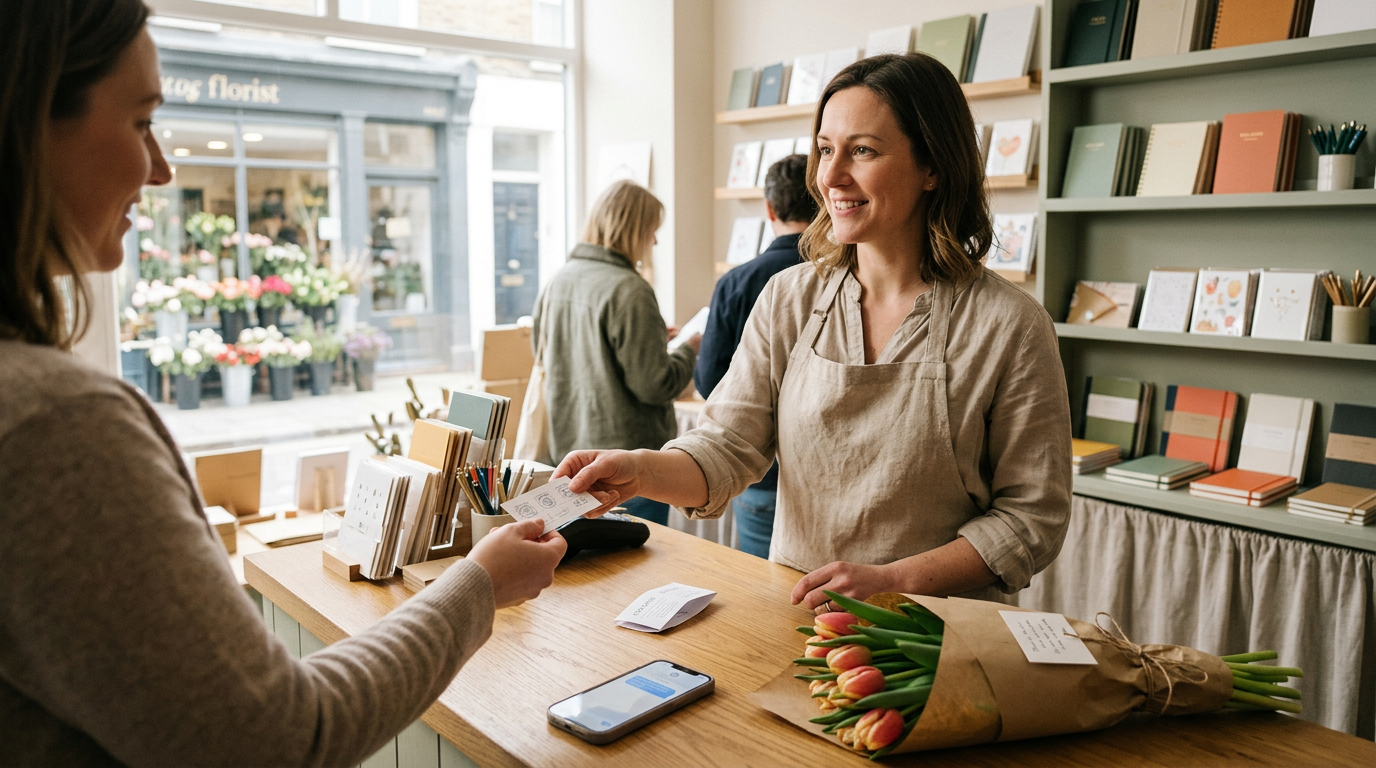
- Business partnerships and public relations (PR): Team up with a complementary business, like a stationery seller who swaps shout-outs with a local florist. Pitching local blogs is PR at its simplest.
Getting orders to customers
Choose the delivery option you can keep up with on a busy week, not the one that sounds best on paper.
- Standard carrier shipping: You pack each order and hand it to a carrier. You control the quality, but you handle every box.
- Dropshipping: A supplier ships the product straight to the buyer. You skip the stockroom but lose some say over packing and timing.
- Buy online, pick up in-store: Buyers order online and collect from you. It’s ideal if you already have a shop or a regular pickup spot.
Tracking results and growing sales
- Sales and point-of-sale (POS) reports: Your POS system shows what sold and when, so you can spot best sellers and slow weeks.
- Customer review insights: Look for patterns, like repeated complaints about slow shipping, and fix those first.
- Expand products and channels: Grow by adding more of what’s working, not everything at once. Let the numbers pick your next step.
Legal and Tax Rules for Online Sales
Before your first sale, you’ll want to know what the law expects and what you’ll owe at tax time.
Rules you must follow to sell
Depending on where you live, you may need to:
- Register your business. Many places ask you to register a business name, even for a side project.
- Check licenses and permits. Some products need their own approval, so ask your local government before you list.
- Follow consumer protection laws. These cover honest descriptions, clear prices, and what buyers are promised on delivery and returns.
- Publish legal website pages. A privacy policy, terms of sale, and refund policy protect both you and your buyers.
- Take payments securely. PCI DSS, short for Payment Card Industry Data Security Standard, covers handling card details. A payment processor that handles card data keeps most of that work off your plate.
A candle maker selling from her kitchen table checks her town’s rules before her first listing goes live, so she never has to pull a product down later.
Can I sell online without GST?
Short answer: it depends on where you live and how much you sell. In many countries, GST (Goods and Services Tax) applies to sales, and small sellers below a set revenue threshold may not need to register. Check first.
Income tax generally applies to the profit from online sales, even for a small shop, so you’ll want to track it. Sales tax may apply in some places, and self-employment tax is a separate charge on what you earn working for yourself.
Keep accurate records by saving receipts, invoices, and a simple sales and expense log. Clean books show your profit rather than just your sales, and tax time gets a lot less painful.
Niche and International Marketplaces to Try
Before you default to the biggest site, check whether a niche or international marketplace puts your item in front of the right buyers.
Niche sites like Ruby Lane and Chairish
A niche marketplace is built around one type of item, so its shoppers already want what you’re selling. Think of a retired teacher with a cabinet of 1950s glassware. On a general site, her plates get lost among thousands of listings.
On Ruby Lane, they sit in front of collectors already searching for vintage pieces. Niche sites are less about reach and more about fit.
- Ruby Lane. Built for vintage and antiques, so buyers arrive hunting for old pieces.
- Chairish. Focused on furniture consignment, where an item is sold on your behalf.
- Bonanza. An eBay alternative. If you already know eBay, the basic idea will feel familiar.
Read each site’s fee terms before you list, since free to join doesn’t always mean free to sell.
Selling on sites in other countries
Selling across borders adds questions you won’t face at home: shipping abroad, what currency buyers pay in, and whether listings need translating. Consider a jewelry maker curious about German buyers.
Testing a few listings on Otto first shows her whether they respond before she translates her whole shop. Start small.
- AliExpress and Taobao. Confirm how cross-border orders are shipped and handled before you list.
- Otto in Germany. Check whether your listings need to be in German before you commit.
- Rakuten in Japan. Review its listing rules and shipping options first.
- Mercado Libre and Flipkart. Check which countries each serves before you assume your items can reach shoppers there.
Selling online for free is very doable when you know what you’re signing up for. Pick the right venue, read the fine print on fees, and write listings that answer a buyer’s questions before they ask.
Keep the safety and legal basics in view, and you’ll dodge most of the surprises that catch new sellers off guard.
Start small, test what sells, and let your results show you when a free marketplace has taken you as far as it can. Your first listing is the hardest one, so go write it today.
References
- Implementing trade‐in programs in the presence of resale platforms: Mode selection and pricing — doi.org (2023)
- Learning from Seller Experiments in Online Markets — doi.org (2011)
- About the Vinted fee — vinted.com (2026)
Questions
What is hot to resell right now?
Popular resale categories include furniture and home goods, name-brand clothing, working electronics, and collectibles or vintage items. Demand varies by product and location, so check similar listings and prices before choosing what to sell.
What are the most popular online marketplaces?
Popular online marketplaces include eBay, Amazon, Etsy, Facebook Marketplace, Mercari, and fashion-focused platforms such as Poshmark, Depop, and Vinted. The best option depends on what you sell: for example, Etsy suits handmade goods, while eBay is well suited to collectibles.
Can I sell online without GST?
Whether you can sell online without registering for GST depends on your country and sales revenue. Many countries set a threshold below which small sellers may not have to register, so check your local tax rules; income tax may still apply to your profit.
Where can you sell items for free online?
You can list items for free on Facebook Marketplace, Nextdoor, OfferUp, and VarageSale for local sales. Craigslist is free for most categories, though some listings may have fees; eBay also offers a limited number of free monthly listings, and many other marketplaces charge fees only after a sale.