GuidesChapter 4 · Online Stores
Etsy vs Shopify for makers: the fees and when to use both
Etsy’s fees and Shopify’s added up at $5,000, $20,000 and $60,000 a year in sales, then what fees don’t show: buyers, your shop’s look and a list to email.
In short
On fees alone, Etsy and a Shopify store cost about the same at $5,000 a year in sales, but Etsy costs about twice as much at $20,000 and nearly three times as much at $60,000. Etsy brings buyers who are already shopping, while your own store gives you a shop that looks like yours and customers you can email, so many makers start on Etsy and add a store as they grow.
Etsy takes a little from every order; Shopify charges a flat plan price plus a card fee. On fees alone they cost about the same at $5,000 a year in sales, roughly $530 on Etsy against $550 on Shopify’s Basic plan. Above that, Etsy costs more: about twice Shopify’s bill at $20,000 and nearly three times at $60,000. Etsy’s fees buy you shoppers who are already looking. Shopify’s bill buys a shop that looks like yours and customers you can email again, but every visitor is yours to bring. That is why many makers start on Etsy and add a store of their own once people know their name.
The short answer
- Start on Etsy if you are testing whether your work sells, nobody knows your name yet, or you sell under about $5,000 a year. You pay as you sell, and Etsy brings the shoppers.
- Open your own store once you have people to send to it: repeat customers, a following on Instagram, a stall at markets, wholesale buyers. Past about $5,000 a year, every order costs you less.
- Use both when you are in between: Etsy finds new buyers, your store serves the people who come back.
What Etsy charges
Etsy has no monthly bill. It charges by the listing and by the order, and these are the fees for a US shop selling in dollars, from Etsy’s Fees & Payments Policy:
- Listing fee: $0.20 per listing. A listing lasts four months or until the item sells, and Etsy renews it for another $0.20 each time, unless you turn auto-renew off.
- Transaction fee: 6.5% of what the buyer pays for the item, the shipping and any gift wrap.
- Payment processing: 3% of the order total plus $0.25, and here the total includes sales tax.
- Offsite Ads: Etsy advertises listings on other sites and charges 15% of the order when a buyer clicks one of those ads and buys from your shop within 30 days. Shops under $10,000 in sales over any 365 days can opt out. Shops past that mark pay 12% instead, can’t opt out, and stay in for the life of the shop. The fee never goes above $100 on one order.
- Set-up fee: many new shops pay a one-time, nonrefundable fee before they open. Etsy tells you during setup whether yours does, and how much.
Etsy Ads, the promoted listings inside Etsy’s own search, are optional: you choose a daily budget and pay per click. They are not counted below.
On a $40 order (a $35 piece and $5 shipping), the listing, transaction and processing fees come to $4.25, about 10.6% of the order. An Offsite Ads sale costs another $6 at 15%, or $4.80 at 12%.
What Shopify charges
Shopify charges a plan, a card fee on each payment, and nothing per listing. These are its US prices from Shopify’s pricing page:
- Basic plan: $29 a month billed yearly ($348 a year), or $39 billed month to month.
- Card fees with Shopify Payments: 2.9% + 30¢ for each standard online card payment on Basic.
- Another payment provider: use one in place of Shopify Payments and Basic adds a 2% fee on top of that provider’s own fees.
- Domain: about $20 a year for a .com.
- Theme: Shopify’s own themes are free; a paid theme from the Theme Store is a one-time cost, often a few hundred dollars.
- Apps: reviews, subscriptions, wholesale pricing and the like are mostly paid apps.
On the same $40 order, the card fee is $1.46, about 3.7%. Everything else is fixed: about $368 a year for the plan and the domain, whether you sell one mug or a thousand.
The fees at three sales levels
Here is the whole fee bill for a year, worked out at three levels. To keep the sums plain:
- every order is $40: a $35 piece and $5 shipping, one item per order;
- every sale renews its listing once, and unsold listings are left out;
- one sale in ten comes through an Etsy Offsite Ad;
- sales tax, Etsy Ads, paid apps and paid themes are left out of both columns;
- the Shopify store uses Shopify Payments and a free theme.
| A year’s fees | $5,000 (125 orders) | $20,000 (500 orders) | $60,000 (1,500 orders) |
|---|---|---|---|
| Etsy listing fees | $25 | $100 | $300 |
| Etsy transaction fee (6.5%) | $325 | $1,300 | $3,900 |
| Etsy payment processing (3% + $0.25) | $181 | $725 | $2,175 |
| Etsy Offsite Ads (one sale in ten) | $0 opted out ($75 if left on) | $240 at 12% | $720 at 12% |
| Etsy total | $531 ($606 with ads) | $2,365 | $7,095 |
| Shopify Basic plan and domain | $368 | $368 | $368 |
| Shopify Payments card fees (2.9% + 30¢) | $183 | $730 | $2,190 |
| Shopify total | $551 | $1,098 | $2,558 |
At the middle and top levels, the shop has already passed Etsy’s $10,000 mark, so its Offsite Ads are on at 12%.
Tip: if you already sell on Etsy, your own numbers beat these. Your Payment account, under Finances in Shop Manager, shows what you paid in fees; set last year’s total against Shopify’s $368 plus 2.9% + 30¢ a payment.
The crossover comes early: with these orders, Shopify’s fixed $368 is paid back at around $5,000 a year in sales, sooner if Offsite Ads are on. Etsy’s share stays at about 11 to 12% of sales however much you sell, while Shopify’s falls as you grow, from 11% of $5,000 to about 4% of $60,000.
But the Shopify column counts only the plan, the domain and the card fees, not what it costs to bring 500 or 1,500 orders to a store nobody has heard of. On Etsy, that is part of what the fees pay for. For the rest of a website’s yearly bill (email at your own domain, apps, renewals), see what a website costs per year when you build it yourself.
Who finds your products
The first time
On Etsy, people are already shopping. Someone types “personalized dog collar” into Etsy’s search, and your listing can be in the results on your first day. Offsite Ads show your work on other sites too. You pay for that reach in the fees, but you don’t have to build it.
A Shopify store starts with no visitors at all. Every buyer comes because you sent them: from Instagram, a craft fair, a newsletter or a Google search. Search takes time for a new store, so start early: how to get your new website on Google has the launch-week steps.
The second time
This is the part the fee table misses. On your own store, you can ask at checkout whether buyers would like your newsletter, then tell them when the new collection lands. On Etsy, the Seller Policy says you may not add a buyer to your mailing list without their consent, and Etsy’s messages aren’t for promotions. A repeat buyer often finds you again through Etsy’s search, and every repeat order pays Etsy’s fees again.
How your shop looks
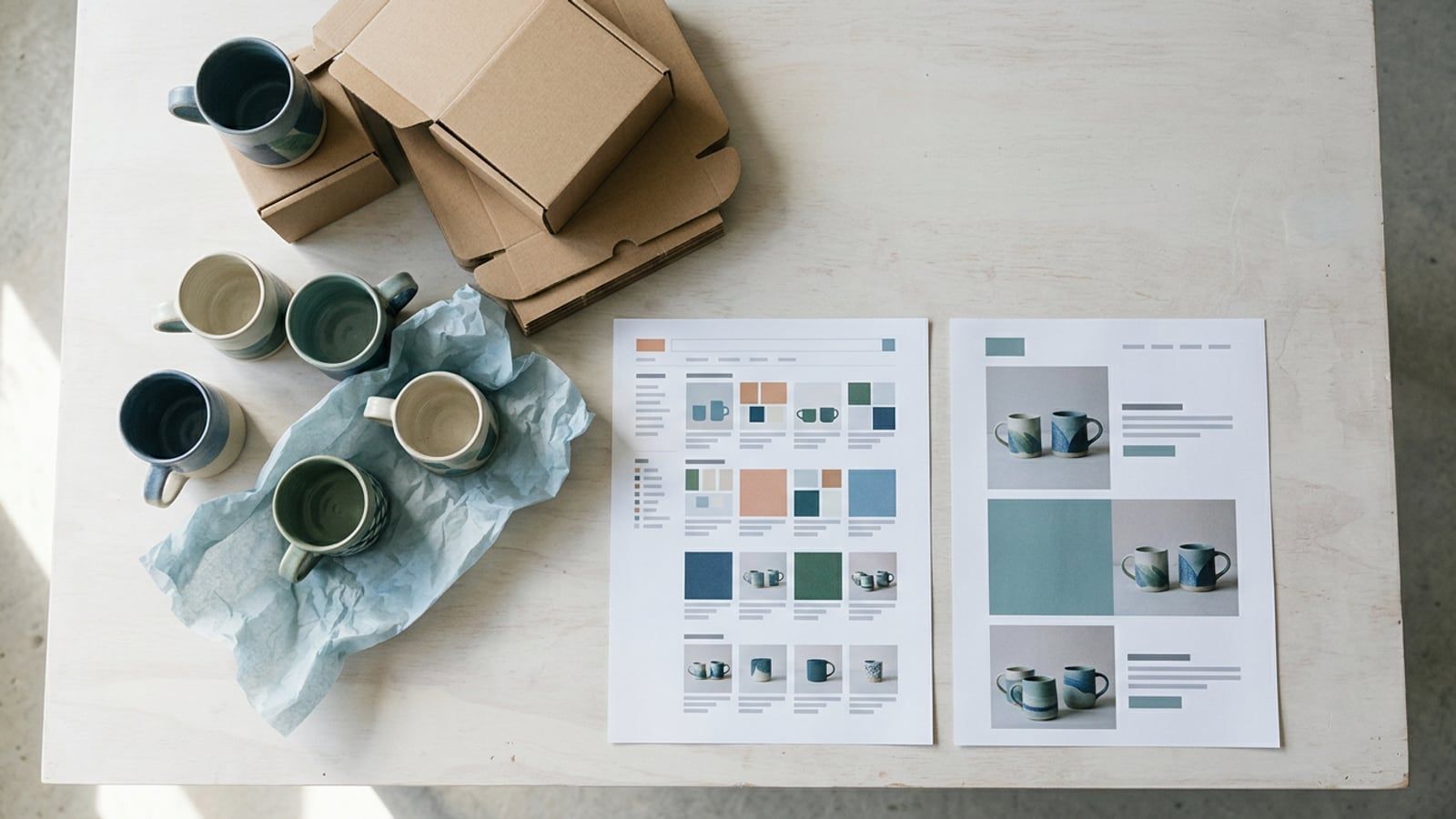
Every Etsy shop has the same layout: a banner, a shop icon, your listings in Etsy’s grid and an About section. Your photographs and your words do all the work of making it feel like yours, and Etsy’s own suggestions, often from other shops, sit around your listings.
A Shopify store wears a theme, so the whole thing can look like your work: your name at your own address, your fonts and colors, the homepage you want, and no one else’s products on the page. Shopify’s free themes go a long way for a maker. Theme Match lists the ones that suit handmade goods, free and paid, with a cost for each year, under shops and makers.
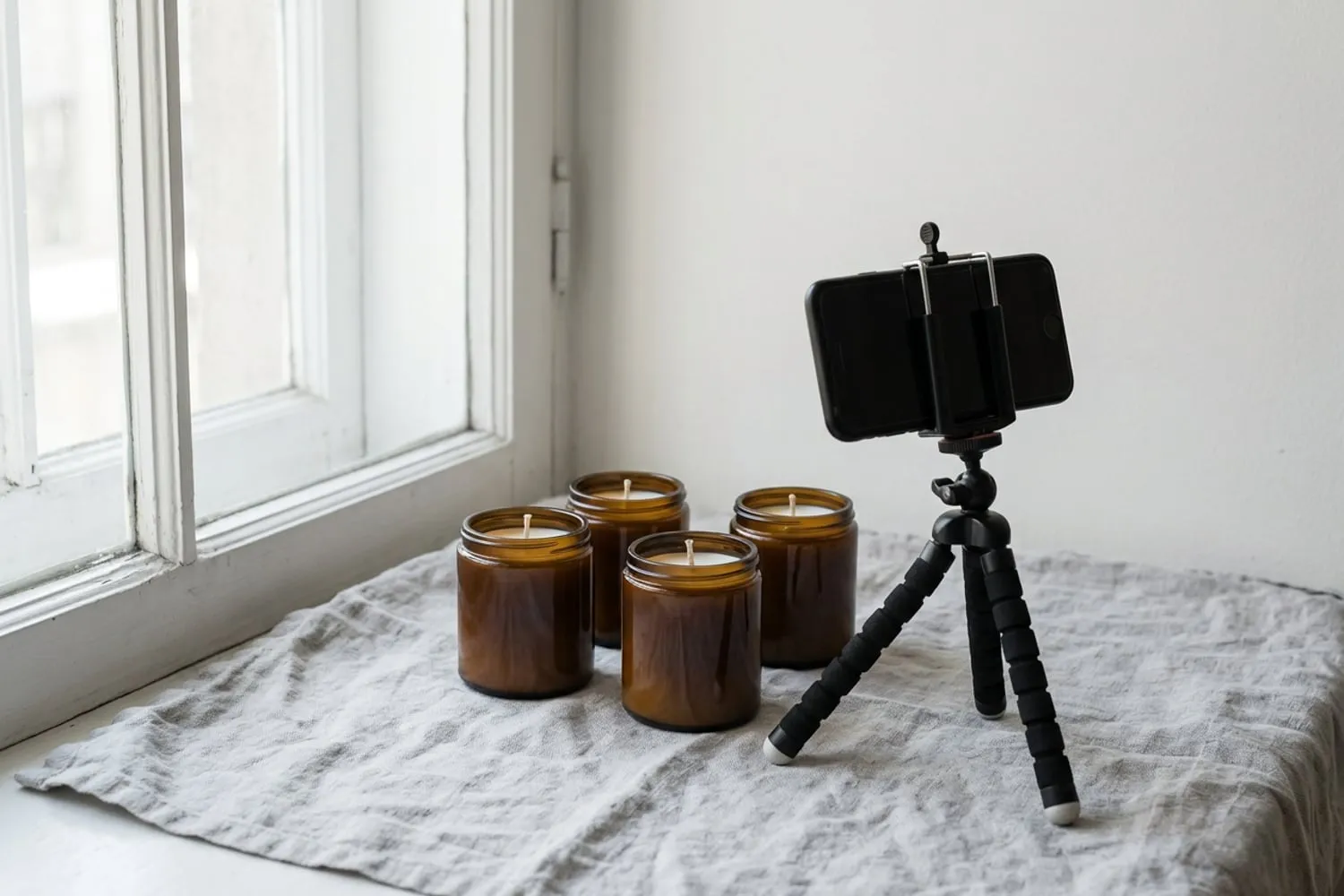
Either way, the photographs do more of the work than the platform. A theme made to look expensive only looks that way with pictures to match; with quick phone snapshots, a plain free theme will look better.
Selling on both
Plenty of makers keep their Etsy shop and add a store of their own. Done well, Etsy brings new buyers and the store looks after the ones who come back.
- Keep your stock in step. A one-of-a-kind piece listed in both places can sell twice. Update both by hand after every sale, or use an Etsy sync app from the Shopify App Store once you’ve checked its price, reviews and last update.
- Keep Etsy buyers on Etsy. Etsy’s Off-Platform Transactions Policy doesn’t let you tell Etsy buyers to buy through your own website, offer them a reason to shop off Etsy, or use QR codes to send them elsewhere. Read it before you put your web address anywhere an Etsy buyer will see it, including what goes in the box.
- Promote your store through your own channels: your Instagram, your market stall, your business cards at fairs, your newsletter and Google.
- Ask before you add anyone to your list. On your own store, a sign-up box at checkout does this. Etsy buyers join only if they say yes.
- Price with the fees in mind. In the sums above, an Etsy order costs about 11 to 12% in fees, against 4 to 6% on your own store once it sells steadily. Many makers charge the same everywhere and treat Etsy’s share as the cost of finding new buyers.
Cheaper ways to run your own shop
Shopify isn’t the only way to have a store of your own, and at small sales it isn’t the cheapest. Here is what the main alternatives cost a year before card fees, which run about 3% wherever you sell (Stripe’s standard US rate, for example, is 2.9% + 30¢).
| Store | Yearly cost before card fees | Fee on each sale | Know this first |
|---|---|---|---|
| Big Cartel Gold | Free | None from Big Cartel; card fees to Stripe or PayPal | Up to five products, one photo each |
| Big Cartel Platinum | $144 billed yearly ($15 a month month to month), plus a domain at about $20 | None from Big Cartel; card fees to Stripe or PayPal | Up to 50 products |
| WooCommerce on WordPress | About $50 in year one, about $150 after (hosting and domain) | Card fees only | You keep WordPress and its plugins updated |
| Squarespace Basic | $228; the domain is free for the first year, about $20 after | 2% to Squarespace, plus card fees | Core, at $348, drops the 2% |
| Shopify Basic | $348, plus a domain at about $20 | Card fees; 2% more with another payment provider | Most extras are paid apps |
Big Cartel’s plans suit an artist with a small range of prints or ceramics; Diamond, at $288 a year billed yearly ($30 a month month to month), takes up to 500 products. WooCommerce costs the least for a full range of products, if you’ll keep up with the updates. Squarespace’s Basic plan takes 2% of product sales, so Core pays for itself once you sell more than about $6,000 a year. All of them are on the Tools page with their prices and a link to each maker, and the Online Stores section has more on running a shop of your own.
Whichever you choose, start from how you want the shop to look and work back to the platform. Theme Match turns five answers into three themes, the platform each one needs and what it costs every year.
Questions
Is Etsy or Shopify cheaper for a small seller?
Below about $5,000 a year in sales, Etsy costs about the same or a little less if you opt out of Offsite Ads, because it has no monthly bill and Shopify’s Basic plan and domain come to about $368 a year before you sell anything. Above that, Shopify’s flat plan and card fees cost less than Etsy’s fees on every order. But Shopify’s figure leaves out the cost of bringing buyers to your store, which Etsy’s fees partly pay for.
Can I sell on Etsy and Shopify at the same time?
Yes, and many makers do. Keep your stock in step between the two so a one-of-a-kind piece can’t sell twice, either by hand or with a sync app from the Shopify App Store. Etsy’s rules don’t let you steer Etsy buyers to buy on your own site instead, so promote your store through your own channels.
Can I opt out of Etsy’s Offsite Ads?
Only while your shop has made less than $10,000 in sales in any 365 days; the setting is under Shop Manager, then Settings, then Offsite Ads. Once your shop passes $10,000, it is in for good at the lower 12% fee, even if sales fall later. Orders from ad clicks made before you opt out can still be charged for 30 days.
Do I need my own website if I already sell on Etsy?
Not to start. Your own site starts to earn its keep when people already know your name: repeat customers, a following on social media, craft fairs, wholesale inquiries. It also gives you a shop under your own address that stays put if a marketplace changes its fees or rules.
Sources
- Fees & Payments Policy, Etsy
- How Etsy’s Offsite Ads Work, Etsy Help
- Off-Platform Transactions Policy, Etsy
- Shopify pricing, Shopify