GuidesChapter 4 · Online Stores
Sales Tax on Online Purchases: How It Works and Who Pays
Sales tax on online purchases varies by state, seller, and shipping destination. See when sellers must collect and what shoppers pay at checkout.

In short
Sales tax on online purchases is a state or local tax added to taxable orders and usually collected by the seller at checkout. Whether tax applies and how much depends on the buyer’s shipping address, the product, and whether the seller has a legal connection to that state, including through sales volume; marketplace rules can also determine who collects it. Sellers should check current rules and set up collection where required, while shoppers may owe use tax if an out-of-state seller does not charge tax.
Picture the checkout page: the cart shows one price, then a few extra dollars appear right before you pay. That line is sales tax, and it’s the part that catches both buyers and new sellers off guard.
In short, sales tax is a percentage a state or local government adds to a purchase, and the seller collects it at checkout. Where the order ships, what’s being bought, and who’s selling all shape whether tax applies and how much.
This guide covers how the rules changed, when a seller has to collect, how states differ, and what a first online store needs to set up from day one.
How Sales Tax on Online Purchases Changed
Whether you had to collect sales tax on an online order used to depend less on what you sold and more on where you had a footprint. Here’s how that rule took shape and how it changed.
Why sellers once needed a physical presence
According to a university research paper on the case, the U.S. Supreme Court decided Quill v. North Dakota in 1992, and the ruling set a clear test.
A state could only require an out-of-state seller to collect its sales tax if that seller had a physical presence there, meaning a real connection to the state.
That rule grew out of the mail-order era, when catalog companies shipped orders across state lines without a local footprint.
The same logic was later applied to internet sales, so a web-only seller with no physical connection to a state generally didn’t have to collect that state’s tax.
What the 2018 Wayfair ruling decided
According to a North Dakota Law Review article, on June 21, 2018, the Supreme Court issued its opinion in South Dakota v. Wayfair, overruling two earlier cases, Quill and Bellas Hess. That replaced the old physical-presence standard.
Now states can require remote sellers, those with no physical presence in the buyer’s state, to collect their tax, regardless of where the seller is located.
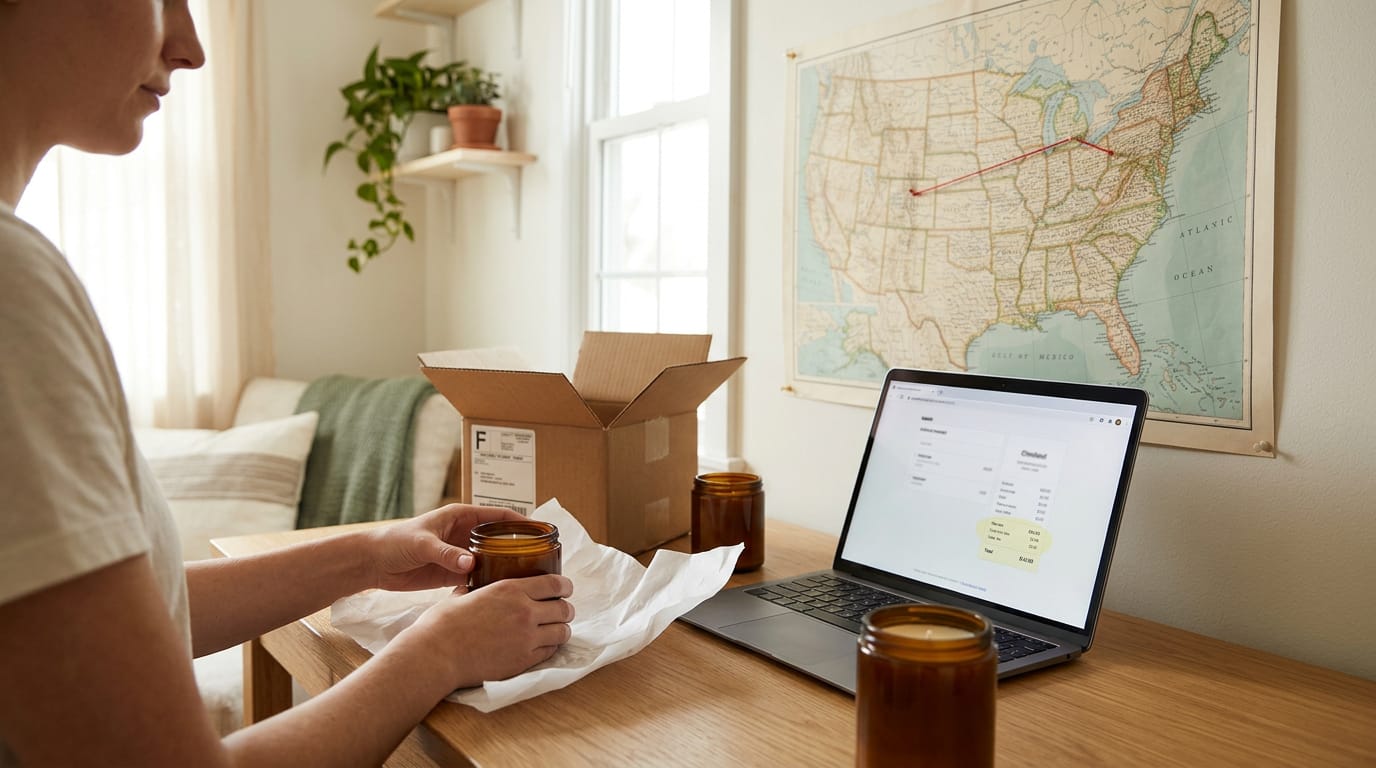
Say you sell candles from your spare bedroom and ship to buyers in another state. Under the old rule, that state couldn’t make you collect its tax without a physical presence there. After Wayfair, it can require you to collect it anyway.
Same candle, same sale, different answer.
Connections and Sales Levels That Trigger Tax
A state needs a legal link to you before it can require tax collection. That link is nexus, and it comes from a connection or from sales volume.
Ways sellers get tied to a state
These connections can create nexus on their own:
- Click-through nexus: an in-state website links buyers to your store for a commission.
- Affiliate nexus: a similar tie, where an in-state affiliate earns pay for each referral.
- Marketplace nexus: selling through a marketplace can change who collects the tax.
- Economic nexus: a tie created by sales volume alone, with no office, inventory, or staff in the state.
- Notice and reporting requirements: states may send letters asking you to register or report, even if you think you owe nothing. Don’t ignore them.
Think of a candle maker selling from her own website. A gift blog in another state links readers to her shop for a commission, and that referral may tie her to the state.
Knowing this before launch lets her plan registration instead of reacting to a letter. The question isn’t just how big your shop is. It’s where your buyers and partners sit. Check early.
Dollar and transaction count cutoffs
Sales levels can also trigger tax, in two main forms:
- Sales dollar minimums: a total dollar amount of sales into the state over a set period.
- Transaction count minimums: a set number of separate orders delivered to buyers in the state.
An either/or threshold structure means crossing either line can trigger tax, not both. These counts focus on tangible personal property, meaning physical goods you can hold, ship, or pick up.
How the Rules Differ Across States
Every state writes its own rules, so there’s no single answer that works everywhere. Is there online sales tax in California? Yes, and it’s a good reminder to check your own state first.
Why the cutoff amounts differ by state
Most states use a threshold, the sales total at which a seller must start collecting tax there. The $100,000 threshold is the most common, but some states set theirs at $250,000 or $500,000.
Some also offer a 200-transaction alternative, so a seller with many small orders can cross the line by count instead of by dollars. Tennessee and South Dakota are useful examples when you want to see the variation up close.
Consider a candle maker working from her kitchen table who checks her monthly sales against her state’s threshold. When she sees she’s getting close, she registers before the holiday rush instead of after a surprise bill.
The question isn’t just what you sell but where your buyers are.

Unusual state rules, repeals, and phase-ins
Some states passed click-through and affiliate laws, which reached sellers through referral links on other websites, and later repealed them. Others phase in thresholds over time, and reporting requirements vary from state to state.
Florida’s pre-Wayfair law is a reminder that these rules have shifted, so an older guide may describe a rule that’s no longer current. Check the current rule, not the one you remember.
Florida’s treatment of digital goods like downloads is its own specific case. Don’t assume a download is tax-free. Confirm the current answer with the state before you price one.
States without sales tax, plus local taxes
These states don’t have a statewide sales tax:
- Alaska
- Delaware
- Montana
- New Hampshire
- Oregon
A state without one can still have city or county taxes, and federal and local rules may differ from what the state suggests. Look locally before you launch.
What Online Sellers Must Handle
Before your first sale, you need to know which states expect tax from you. Where you’re located, where buyers are, and what you sell all matter.
Registering and collecting tax in each state
Once you have a nexus (a legal connection to a state, such as an office or enough sales there), you’ll generally register, collect tax on taxable orders, and remit it (send it in on schedule).
Many states make the marketplace facilitator (the platform hosting your sales) responsible for collecting on sales made through it, so check your platform first. When you set up your store, check that you’ve:
- Entered your correct business address.
- Turned on automatic tax calculation or set state rates.
- Marked which products are taxable.
Rules vary by state, and digital downloads like printables or ebooks may be taxed differently too.
What states lose on untaxed online sales
A Government Accountability Office (GAO) estimate found that state and local governments could have collected up to $13 billion more in sales taxes in 2017 if remote sellers had been required to collect them.
For a state-level view, look at Tennessee’s projected revenue before you plan.
Deciding where to collect, with accountant help
Origin-based states tax orders where your business sits, while destination-based states tax them where the buyer lives. Consider a candle maker shipping from her home studio to buyers in several states.
Her studio may set the rules for some orders, while each buyer’s address sets them for others. Sorting that out before launch saves her from a surprise bill at filing time.
The real question is less about where you sit and more about where your sales land. Check first.
An accountant can map out which states apply to you, so bring a list of your sales by state.

Where Shoppers Stand on the Tax
Whether you pay tax on an online order depends less on where the shop is and more on where you live. The tax usually follows the address your order ships to.
Who pays depending on where you live
Your residence decides who owes tax. Online buying is a big slice of retail: PYMNTS reports that eCommerce accounted for 17.1% of U.S. retail sales in the second quarter, up from 16.3% a year earlier. Non-U.S. residents are unaffected by these U.S. rules.
GST (goods and services tax) is a different tax used in other countries, not part of U.S. sales tax, so whether it applies depends on the rules where you live.
Use tax still applies to out-of-state orders
Many shoppers think ordering from another state means no tax. That’s the tax-free shopping myth. The order isn’t tax-free, it’s just unpaid at checkout. The tax you owe is use tax.
According to the Government Finance Officers Association, 45 states and the District of Columbia impose it on taxable out-of-state purchases. Sellers don’t always apply it, and most buyers don’t know they owe it.
The use tax rate matches the sales tax rate where the order ships.
What if an online shop skipped tax?
If a shop didn’t charge you, you still owe the tax. Think of a retired teacher starting a craft blog who orders fabric from an out-of-state shop that charges nothing at checkout.
She owes use tax at her home state’s rate and reports it with her annual income tax return. No surprise bill later. Keeping track of every small order is hard, though.
Depending on your state, an income-based estimate may be allowed instead of totaling every receipt, so check your state’s guidelines first.
Sales tax on online purchases comes down to a few questions: where the buyer is, what’s being sold, and whether the seller has to collect. Once you know those answers, the total at checkout stops being a surprise.
If you’re launching your first store, do the setup work before the first sale. Confirm where you need to collect, set your tax settings before launch, and keep clear records from day one.
Get the rules right early, and tax becomes one less surprise on the way to your first sale.
References
- The Court’s Jurisprudence on U.S. State Tax Jurisdiction―Quill Corp. v. North Dakota By and Through Heitkamp, 504 U.S. 298 (1992) ― — chuo-u.repo.nii.ac.jp (2017)
- Overturning Quill: Why Wayfair Was Correctly Decided and What Lies Ahead — commons.und.edu (2018)
- Essays on Taxes, Guns, and Education — tigerprints.clemson.edu (2019)
- PYMNTS — pymnts.com (2026)
- Marketplace Fairness Act & The Remote Transactions Parity Act… — gfoa.org (2025)
Questions
What is GST tax?
GST, or goods and services tax, is a consumption tax used in some countries. It is separate from U.S. sales tax, and whether it applies depends on the rules where you live.
What is the $600 tax rule?
There is no single U.S. “$600 tax rule” for online sales. You may be thinking of a reporting threshold for certain payments, but payment reporting rules do not determine whether income is taxable or whether sales tax is owed; sales tax collection generally depends on state rules and a seller’s nexus there.
Is there online sales tax in California?
Yes. California has sales tax on taxable online purchases, and the seller may be required to collect it based on the destination, the product, and the seller’s connection or sales volume in California. If the seller does not collect tax on a taxable purchase, the buyer may owe use tax.
Is GST applicable on online shopping?
GST can apply to online shopping in countries that impose GST, depending on local rules and the goods or services purchased. In the United States, GST is not used; sales tax rules apply instead.
What do I do if an online shop didn't charge me sales tax?
If the purchase was taxable and the shop did not collect tax, you generally owe use tax at the rate for where the order was delivered. Report it using your state’s process, often on your state income tax return, and check whether your state allows an estimated amount instead of listing each purchase.
Does Florida have sales tax on digital goods?
Florida’s treatment of digital goods depends on the type of download and current state rules. Downloads such as ebooks or other digital products should not be assumed tax-free, so check Florida’s current guidance for the specific item.
When ordering online, how is sales tax calculated?
Sales tax is generally calculated using the applicable rate for the order’s shipping destination, though some states use origin-based rules. The rate may combine state, county, city, and other local taxes, and whether tax applies depends on the product and the seller’s obligation to collect.
Sources
- The Court’s Jurisprudence on U.S. State Tax Jurisdiction―Quill Corp. v. North Dakota By and Through Heitkamp, 504 U.S. 298 (1992) ―, chuo-u.repo.nii.ac.jp,
- Overturning Quill: Why Wayfair Was Correctly Decided and What Lies Ahead, commons.und.edu,
- Essays on Taxes, Guns, and Education, tigerprints.clemson.edu,
- PYMNTS | eCommerce Takes 17.1% of Retail Sales Amid Online Growth, pymnts.com,
- Marketplace Fairness Act & The Remote Transactions Parity Act…, gfoa.org,